
XPO Logistics
Consumer delivery tracking for heavy freight
Five months
Where-is-my-order calls dropped 34% once we replaced “Out for delivery” with an actual time window.
The business problem
Heavy freight is an appointment business, and the appointment was invisible.
XPO’s last-mile network delivers the things you cannot leave on a porch: treadmills, exercise bikes, appliances, furniture. Every one of those deliveries requires a human being to be at home, which makes it an appointment business dressed up as a shipping business. A failed first attempt triggers a second full dispatch — two people, a truck, a route slot — and it is the single most expensive event in the network.
Retail partners felt it as a relationship problem. A customer spent two thousand dollars on a bike, and then spent a week in the dark. They called the retailer; the retailer called XPO. Contact-centre volume and failed-attempt rates were both contractual line items XPO carried, so the cost landed in two places at once.
Consumer interviews were unusually unanimous. The expected delivery time window was the single most important piece of information, ahead of everything else we tested. And the most hated string in package tracking — named unprompted in nearly every session — was “Out for delivery” with no window attached: technically true, operationally useless, and impossible to plan a day around.
The reframe
A status is not a step. It’s a promise with a time on it.
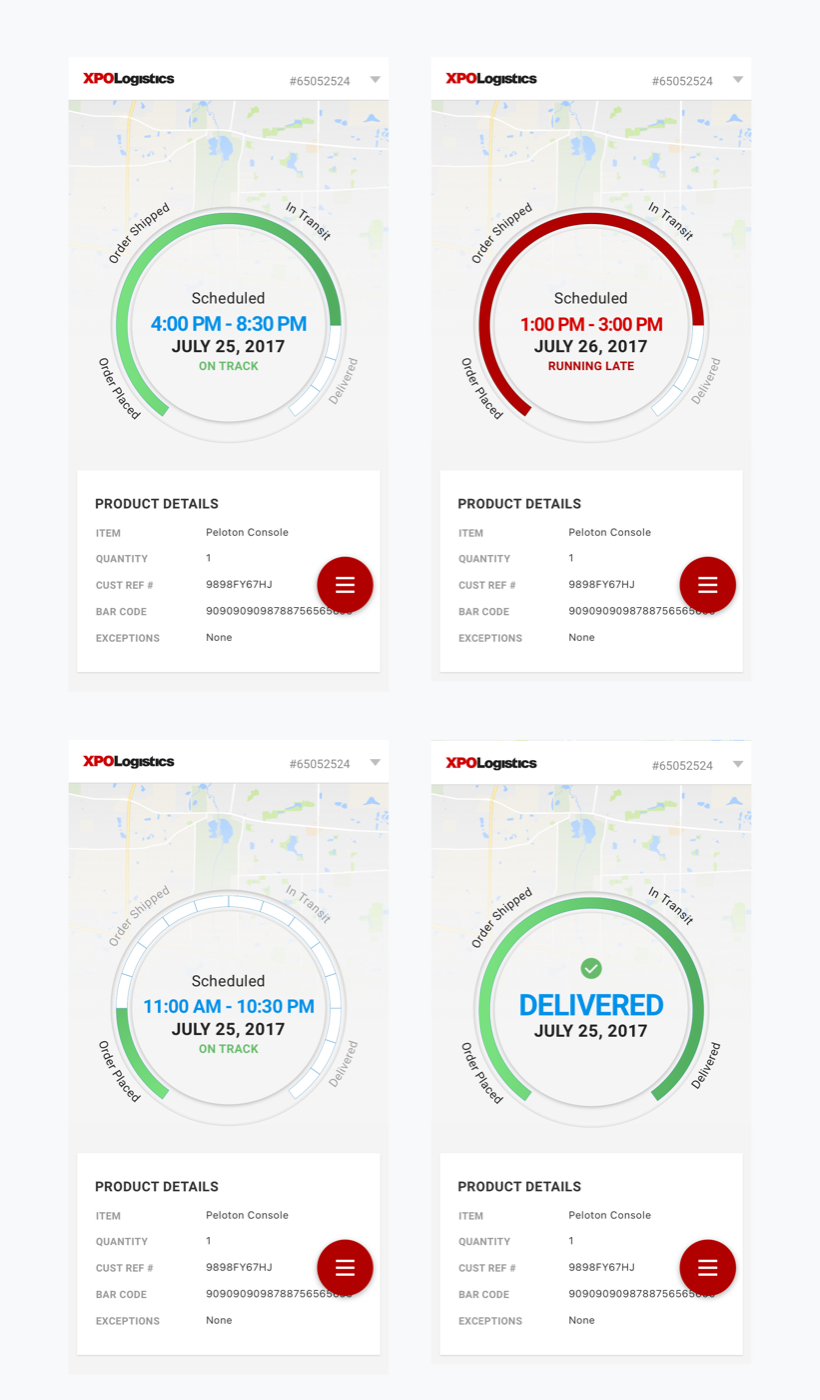
Every tracking product we studied modelled delivery as a progress bar of completed steps: ordered, shipped, in transit, out for delivery. But consumers do not care which step you are on. They care whether they need to be home this afternoon. So the primary object became the window — 4:00 – 8:30 PM, July 25 — set in the largest type on the screen, with the pipeline arranged around it as context rather than as the headline. The ring exists to make the window the centre of the composition, not because delivery is circular.
The work
The window first, the status second, the parcel details last.
Explorations that died
-
01 / 03
Horizontal step tracker
It is the default in every carrier app, and consumers read it as “somewhere between shipped and delivered” — which is exactly the state they were already frustrated by.
-
02 / 03
Live map with a truck pin
Fleet telematics could not guarantee position accuracy across every route, and a stale pin is worse than no pin. It also implied an ETA precision operations could not honour.
-
03 / 03
Countdown to arrival
It converts a window into a point, so every minute past zero reads as a broken promise. Windows are honest about uncertainty; countdowns are not.
Tradeoffs
What got cut, and why.
- Self-service rescheduling. Consumers could see the window and request a change; committing to a new slot in-app required a write path into dispatch that operations was not ready to expose to the public internet. Request-and-confirm shipped at launch and full self-service followed later, which was the right sequence even though it read as half a feature.
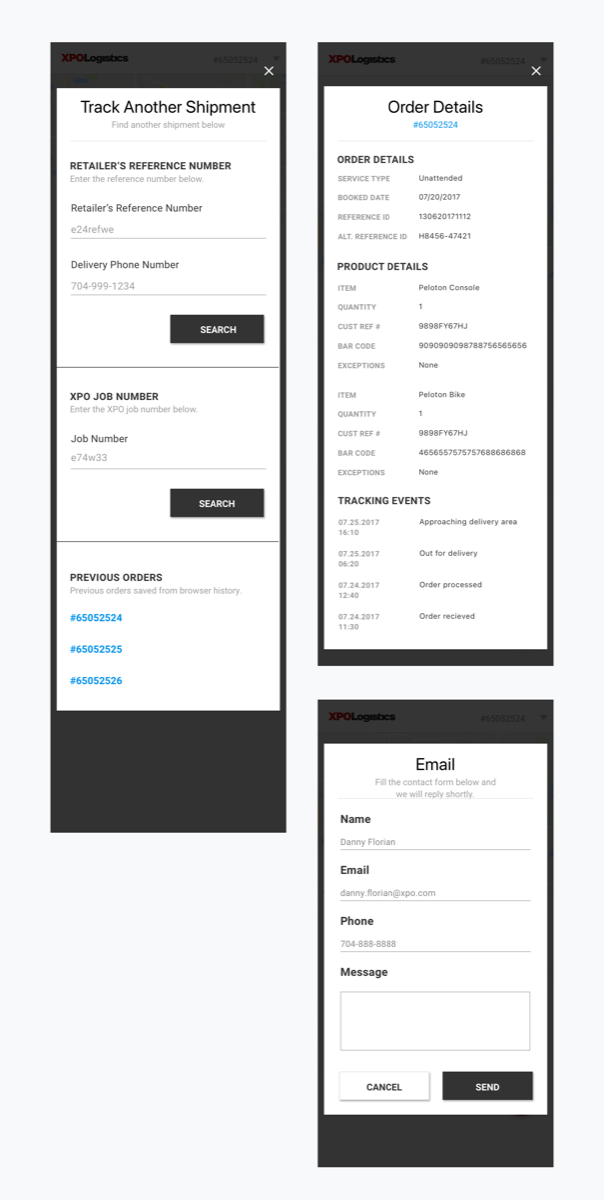
- Accounts and login. Tracking is keyed on reference number plus phone, with history in browser storage. We gave up personalisation, saved addresses, and any chance of a marketing list, in exchange for a flow that works the first time from an SMS link.
- Per-partner theming. Retail partners wanted their own skin on the experience. We shipped one XPO-branded interface with a partner logo slot, because eight themes is eight regression surfaces on a status system whose entire value is that it never lies.
- Native apps. This is a once-a-year interaction reached from a text message. Mobile web was the correct medium, and we wrote that down explicitly so the question would stop coming back every quarter.
Impact
Where-is-my-order contacts fell 34%.
-
−34%
Inbound “where is my order” contacts.
Measured: partner contact-centre tickets categorised “delivery status” per 1,000 shipments, six months before vs. six months after rollout on the pilot partner.
-
−11%
Failed first-attempt deliveries.
Measured: XPO dispatch records on the pilot lane, same windows. Attributed to the window plus the day-before SMS reminder, which shipped together.
-
78%
Of tracked shipments opted into SMS.
Measured: opt-in events divided by unique tracking sessions during the first quarter after launch.
Reflection
The ring tested well because it made the window the largest thing on the screen, not because it was a ring — I would resist any future pressure to make it a nicer ring. What I would change is the vocabulary: “Running late” shipped in red without a revised window attached, which answers a question nobody asked and leaves the real one open.